Nuts
-
Featured Crop
After three years, a trial testing whether retaining leaf litter under macadamia trees improves soil health is wrapping up, with growers awaiting the final report on what it means for sustainability and profitability.
The 2026 macadamia harvest in Bundaberg is drawing to a close as the Queensland Department of Primary Industries (DPI) completes the final harvest of a three-year soil health trial.
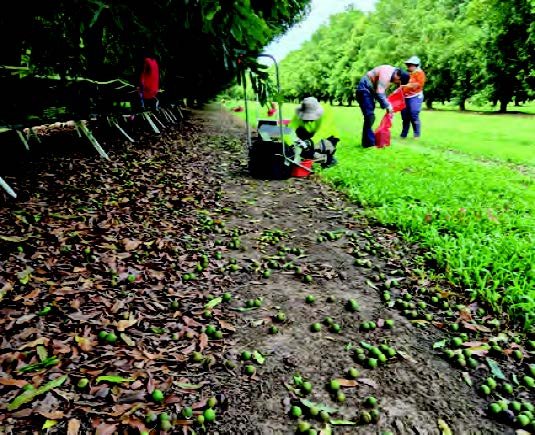
The trial uses temporary netting installed under commercial orchard trees to divert nut fall into the interrow, prevent soil disturbance and retain leaf litter year-round across the “magic metre”, the critical rootzone area beneath each tree. DPI researchers have been tracking the effect on nut yield and kernel quality, alongside soil condition and on-farm water quality, monitoring nutrient and sediment loads and losses, soil microbial and nematode populations, and leaf litter cover and depth.
Harvest is done with hand-pushed fingerwheel harvesters, allowing individual tree yield data to be collected and compared. Nuts are weighed on site, then taken to the DPI Research Facility for de-husking, drying and kernel quality assessment, tracking differences in nut recovery and product quality against soil health and water quality outcomes between conventional control plots and netted plots.
Over three years, the trial has tested whether reduced soil disturbance across the magic metre, combined with long-term leaf litter retention, improves soil health, benefits feeder roots and cuts nutrient and sediment losses on farm.
Comparing netted and conventional plots over time is giving researchers insight into how orchard floor management can lift productivity and profitability while reducing risk to reef water quality, evidence for the sustainability case of Queensland’s macadamia growers. The final report is expected shortly.
More information: DPI’s farming and reef water quality projects