

Avocado
-
Featured Crop
Talha Shahzad Nut crop & stone fruit agronomist.
Unseasonal rainfall during the 2026 almond harvest created ideal conditions for hull rot across major almond-growing regions.
Prolonged humidity, extended leaf wetness, and delayed harvest increased disease pressure, particularly on Nonpareil.
While hull rot is a familiar issue, the 2026 season highlighted how quickly risk can escalate when weather conditions align with susceptible crop stages.
Hull rot is a fungal disease that develops after hull split and is commonly associated with pathogens such as rhizopus, monilinia, and aspergillus.
Infection begins in the hull, but its impact extends beyond the current crop.
Toxins produced by the fungi move into fruiting spurs, causing spur death and reducing flowering potential in the following season. As a result, unmanaged hull rot can have both immediate and carry-over yield impacts.
Why hull rot increased this season
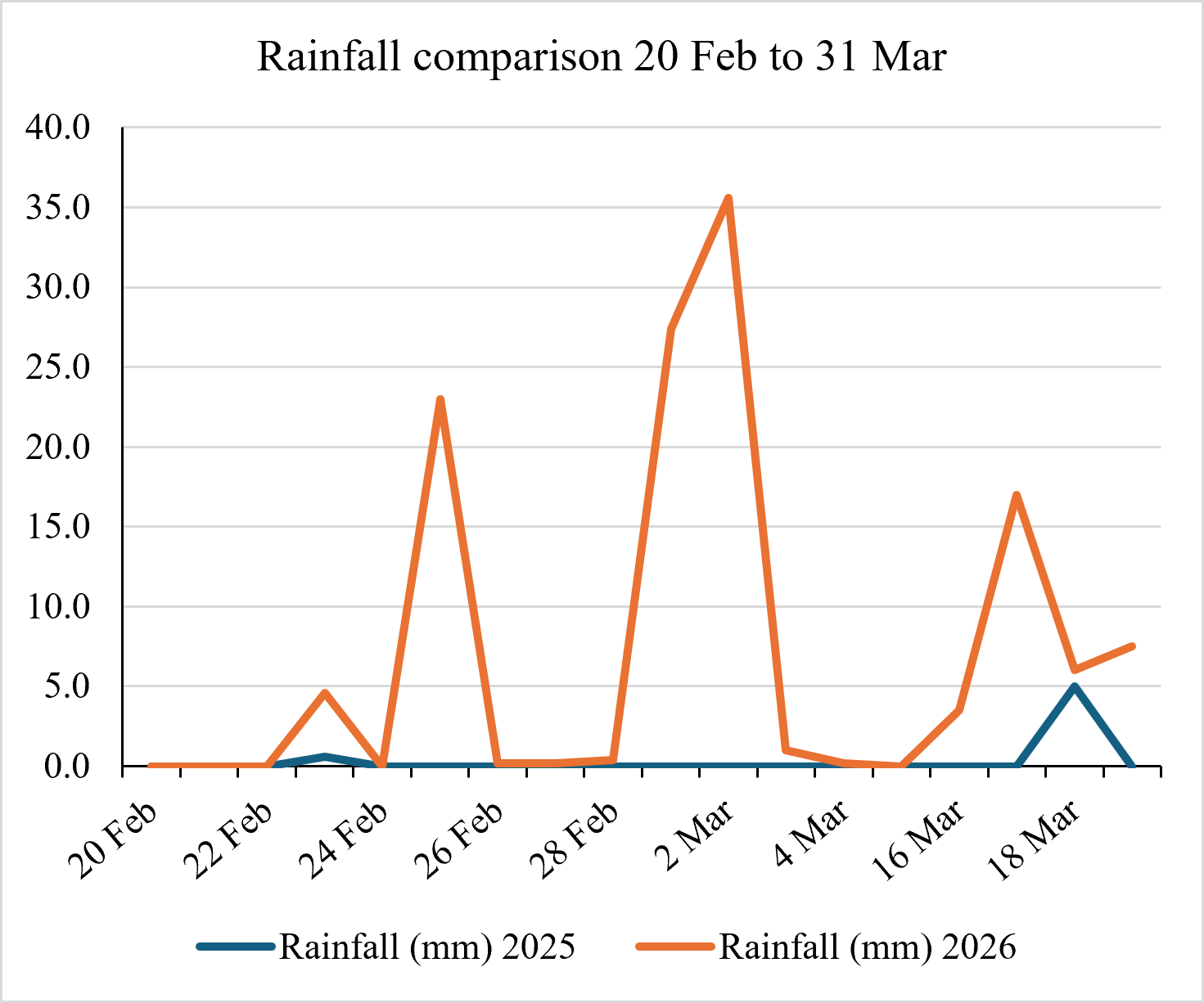
Compared with the previous year, the 2026 harvest period was characterised by frequent rainfall events and consistently high relative humidity (Figure 1). In many orchards, leaf wetness persisted for more than 24 hours, creating favourable conditions for fungal development. These conditions coincided with hull split, the most vulnerable stage for infection.
By contrast, the 2025 season experienced dry conditions, low humidity, and an earlier harvest, resulting in minimal disease pressure. This seasonal comparison reinforces the strong influence of weather on hull rot development.
Key risk factors
Hull rot risk is influenced by a combination of environmental conditions and orchard management practices. The most important contributors include:
- susceptible varieties, particularly Nonpareil (with Wood Colony and Price showing moderate susceptibility)
- elevated January leaf nitrogen levels, especially above 2.5 per cent
- lack of irrigation reduction during hull split
- rainfall and high humidity during the hull split period
- dense canopies that restrict airflow and increase humidity
When several of these factors occur together, the likelihood and severity of hull rot increase significantly.
Recognising hull rot in the field
Symptoms typically appear shortly after rainfall events during hull split. Early detection is important for assessing risk and guiding management decisions.
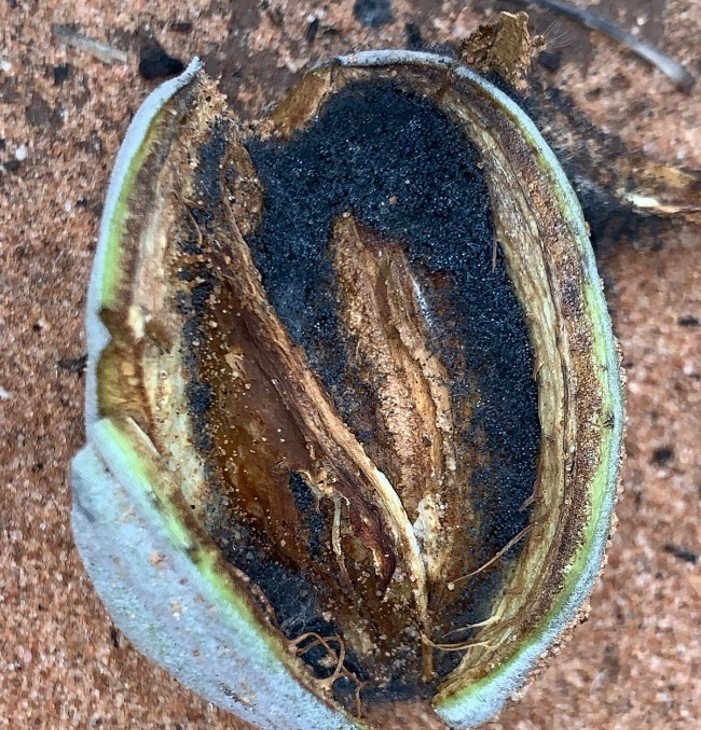
Infected nuts often show brown to black fungal growth between the hull and shell in hull rot by Rhizopus stolonifer, whereas tan discolouration of the outside of hulls by Monilinia lexa.
In more advanced cases, growers may observe shoot dieback, commonly referred to as “flagging,” and the loss of fruiting spurs, termed as hull rot strikes.
These symptoms are a clear indication that the disease is affecting next season’s production potential.
Impact on yield and thresholds
Hull rot primarily affects yield through spur death, which reduces the number of viable flowering sites in the following season. The severity of impact generally increases with the number of infected sites (strikes) per tree.
As a practical guide:
- Fewer than 60 strikes per tree are considered low risk
- Between 60 and 200 strikes indicate moderate risk
- More than 200 strikes suggest that management intervention is required
- Above 500 strikes per tree can lead to significant yield loss
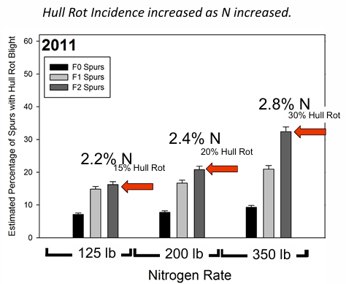
Higher nitrogen levels and favourable environmental conditions can accelerate disease development, making early intervention critical in high-risk blocks (Figure 2).
Monitoring and record keeping
Regular monitoring during hull split is essential. Growers should assess the number of hull rot strikes per tree and maintain block-level records to track trends over time. This information is particularly valuable for identifying high-risk areas and refining management strategies in subsequent seasons.
Management strategies
Effective management of hull rot relies on a combination of cultural practices and, where necessary, targeted chemical control. Cultural management remains the foundation of control and should be prioritised wherever possible.
Cultural management
Nitrogen management plays a central role in reducing risk. Leaf nitrogen levels should be maintained at or below 2.5% by early January. Excess nitrogen, particularly from late-season applications, increases susceptibility by promoting dense canopies and delaying hull split. In blocks with a history of hull rot, it may be beneficial to cease nitrogen applications once kernel development is completed and, if required, apply nitrogen post-harvest instead.
Irrigation management is equally important. Applying mild water stress at hull split typically a 10–20 per cent reduction in irrigation can help lower canopy humidity and reduce disease development. As a guide, stem water potential should be maintained between -14 and 18 bar during this period.
Maintaining an open canopy also contributes to disease suppression. Pruning dead wood and improving airflow reduces humidity within the tree, making conditions less favourable for fungal growth. In addition, a timely harvest is critical. Early harvest can significantly reduce the window of exposure to infection, particularly in seasons with frequent rainfall.
Chemical control
Chemical control should be considered a supplementary tool and is most effective when used strategically in high-risk situations. These include blocks with a history of high hull rot incidence, elevated nitrogen levels, or when rainfall is forecast during hull split.
Fungicide applications are most effective when applied at early hull split (approximately 1–10 per cent), depending on the product. Sprays should ideally be applied ahead of rainfall events to ensure adequate uptake and protection.
A range of fungicide groups, including DMI (FRAC 3) and strobilurin (FRAC 11) chemistries, are available for hull rot suppression. It is essential to rotate modes of action to minimise the risk of resistance development and to strictly follow label recommendations, including withholding periods and application timings(see the table at the end).
Conclusion and take-home messages
The 2026 season demonstrated how strongly environmental conditions can influence hull rot risk.
Even well-managed orchards were exposed to higher disease pressure due to prolonged wet conditions during hull split.
This highlights the need for flexible, seasonally responsive management strategies.
Maintaining control of hull rot comes down to a few critical practices:
- keep leaf nitrogen at or below 2.5 per cent by early January
- apply mild water stress at hull split to reduce canopy humidity
- early harvest to reduce the chances of hull rot incidence
- monitor and record hull rot strikes to guide decision making
- use fungicides strategically in high-risk situations
- respond proactively to weather conditions during hull split
With increasing input costs, particularly for fertiliser and water, optimising orchard management is more important than ever.
Managing nitrogen and irrigation not only reduces hull rot risk but also improves overall production efficiency.
A balanced, data-driven approach will help growers minimise losses and maintain productivity in variable seasonal conditions.

