
Water supply & irrigation
Alessio Scalisi, Mark O’Connell and Simone Nesi Agriculture Victoria
Knowing when to irrigate is one of the hardest decisions in fruit production.
Too little water can reduce yield, fruit size and tree health. Too much wastes a scarce and expensive resource.
A new Agriculture Victoria study is testing whether sensors mounted directly on the tree can give growers a clearer, continuous picture of plant water stress in almond, nectarine and pear orchards.
Why plant-based monitoring matters
Most growers already use a combination of soil moisture readings, weather data and experience to guide irrigation. These tools are useful, but they do not always show how the tree itself is responding. Plant-based measurements can fill that gap because they reflect the combined effects of soil moisture, weather conditions, root access and the tree’s own water-use behaviour.
The pressure chamber remains a reliable way to measure stem water potential, but it is labour-intensive and only provides snapshots in time. For busy commercial orchards, the next step is continuous monitoring that can track changes throughout the day, during heat events and after irrigation or rainfall.
Testing sensors in real orchard conditions
The study was conducted during the 2025–26 growing season in nectarine and pear blocks at Tatura SmartFarm and an almond block at Mildura SmartFarm. Trees were exposed to three irrigation regimes: a fully irrigated control, a severe stress treatment where irrigation was withheld and then restored, and a rainfed treatment.
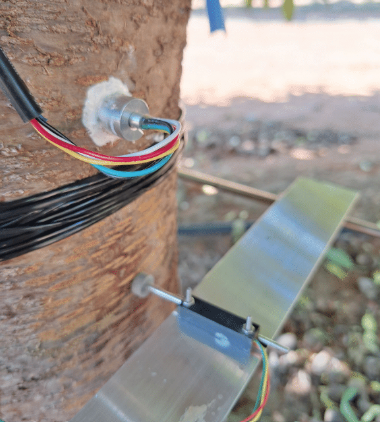
Two types of trunk-mounted sensors were tested.
Microtensiometers measured xylem water potential inside the tree, providing a continuous indication of plant water status.
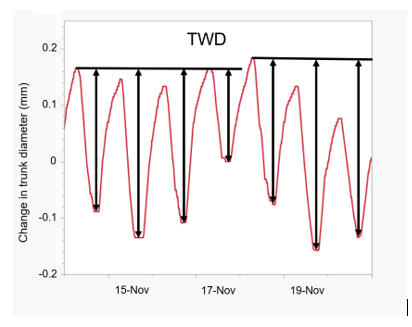
Dendrometers measured tiny changes in trunk diameter, which can show when a tree is shrinking during the day, recovering overnight or slowing its growth under stress.
What the sensors showed
The microtensiometers closely tracked changes in tree water status across almond, nectarine and pear. They responded to irrigation treatments, rainfall and high evaporative demand, and their readings aligned strongly with conventional stem water potential measurements. Importantly, the relationship remained strong when results from all three crops were considered together, suggesting the technology has broad potential across orchard species.
The dendrometers also provided useful information, but not all indices were equally reliable. Maximum daily shrinkage and trunk growth rate were sometimes influenced by species, weather and tree characteristics. Tree water deficit, however, consistently separated the irrigation treatments in all three crops, making it the most promising dendrometer-derived indicator in this study.
Different crops respond differently
One of the clearest messages for growers is that different fruit crops do not respond to water stress in exactly the same way. In the study, pear and almond trees showed strong overnight recovery in xylem water potential after hot, dry days, while nectarine trees showed a more progressive decline and less complete overnight recovery under stress.
These differences likely reflect crop physiology, root access to soil moisture, canopy structure and the amount of water stored in woody tissues. For growers, this reinforces the need to interpret sensor data in the context of crop type, block history, soil conditions and seasonal weather.
What this means for irrigation decisions
Continuous trunk-based sensors are valuable tools, but they do not replace grower experience, soil moisture monitoring or weather data. Their value is in showing how the tree is actually coping in real time, especially during heatwaves, rapid changes in evaporative demand or periods of limited water availability.
Microtensiometers appear particularly useful where accurate, real-time information on plant water status is needed. Dendrometers may offer a lower-maintenance and potentially more cost-effective option, but the choice of index matters. Based on this work, tree water deficit is likely to be more useful than single-day shrinkage or growth measurements when assessing cumulative water stress.
Key take-home messages for growers
- Plant-based sensors can show how trees respond to water stress in real time.
- Microtensiometers provided reliable continuous measurements of plant water potential across almond, nectarine and pear.
- Dendrometers showed promise in orchards with some indices more useful than others.
- Tree water deficit was the most consistent dendrometer-based indicator of irrigation treatment differences.
Looking ahead
The results are encouraging, but further work is needed before sensor thresholds can be confidently applied across different orchards and seasons. Future research will need to consider crop load, canopy size, trunk diameter, rootzone differences and the role of stored water in helping trees withstand short periods of drought. Relationships between tree stress indices and productivity in the same and following seasons must be further investigated to support profitable orchard management.
For now, the message is clear: listening directly to the tree can give growers another powerful layer of information for irrigation decisions. As water becomes more limiting and climate variability increases, continuous plant-based monitoring could become an important part of smarter and more responsive orchard management.