

Pome fruit
-
Insect & mite control
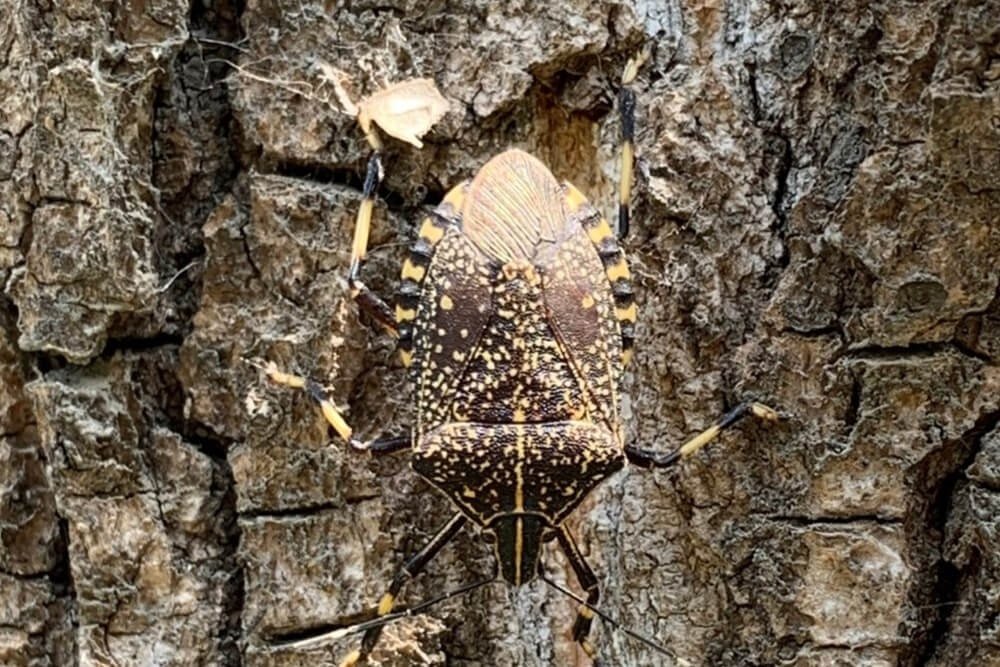
You may be familiar with the brown marmorated stink bug (BMSB), but how much do you know about its dotted relation, the yellow spotted stink bug ( Erthesina fullo )?
Following a spike in border detections during the 2023–24 season, the yellow spotted stink bug (YSSB) was added to Australia’s National Priority Plant Pests list.
Like BMSB, this pest poses a serious biosecurity risk due to its ability to rapidly form huge populations and cause damage to a wide range of crops.
Not to mention their ability to infest households and, as their name suggests, emit a strong unpleasant odour.
Better understanding this emerging threat and how it can be managed is critical for protecting Australia’s agriculture, environment and communities.
With this pursuit of knowledge in mind, departmental scientists partnered with the Centre for Agriculture and Bioscience International (CABI) on two research trips to countries where YSSB is already established.
With a global network of laboratory facilities, CABI collaborates with agencies worldwide to tackle some of the biggest agricultural challenges, including responding to invasive pests.
In mid-2024, its technical response director visited CABI’s quarantine facility in Switzerland, where researchers are rearing YSSB to study its lifecycle and behaviour.
Together with a CABI researcher, they then travelled to Durres, Albania, a port city heavily infested with YSSB, where they observed feeding habits and noted large-leaved linden trees (Tilia platyphyllos ) and oriental plane trees (Platanus orientalis ), commonly used in Australian street planting, are among the bug’s preferred hosts.
In late 2024, one of CABI’s senior entomologists and a senior technical response field coordinator visited Beijing where researchers are conducting lab and field experiments.
These include:
- Testing various light trap designs.
- Improving field detection methods.
- Conducting gut content analysis to understand feeding patterns.
In parts of China, YSSB has become a significant agricultural pest, damaging crops such as kiwifruit, pear, macadamia, and others. The stink bugs feed on the leaves, flowers, shoots, and fruit, creating entry points for plant pathogens to infect the plants.
Thanks to these international collaborations and research efforts, the department is now better placed to detect and respond to YSSB and protect our crops and environment from the devastation this pest has caused overseas.
These learnings and insights will also be incorporated into the review of the National Hitchhiker (Contaminating) Plant Pest Action Plan – which provides a national collaborative approach to preparedness for hitchhiking pests.
For more information about stink bugs go to https://www.agriculture.gov.au/biosecurity-trade/pests-diseases-weeds/plant/identify/brown-marmorated-stink-bug
And don’t forget, if you see something unusual, report it at the exotic plant pest hotline on 1800 084 881.

