

Pruning
By Ceilidh Meo, managing director, Long Road Olive Co-op Ltd
Olives play a number of roles in the farm landscape; they can be the main production enterprise, but they are also valued for their beauty as specimen trees as well as privacy hedging and windbreaks.
Wherever they are planted, they will require pruning and the ultimate aim for the plantation will determine the best approach.
Olive trees respond differently to pruning than other fruit trees because of their growth habits, and lack of a deciduous dormancy period.
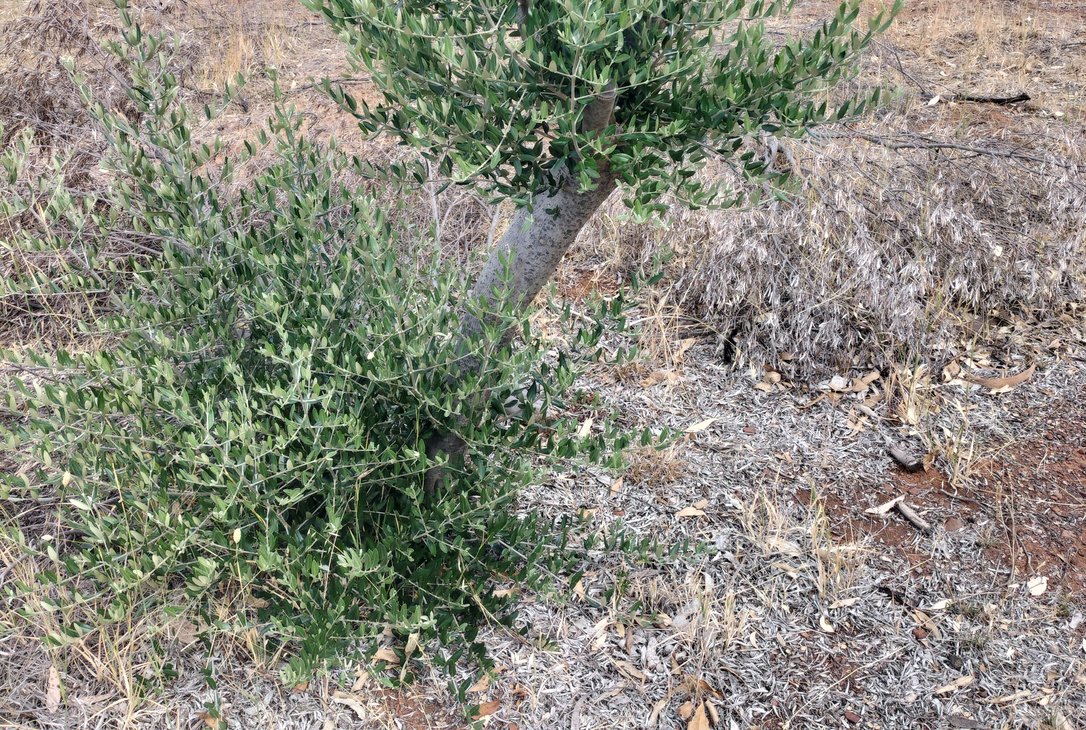
It is best practice to remove no more than 30-50 per cent of the canopy in any year or the trees can go into shock.
However, olives are extremely hardy and will survive the removal of the full canopy by suckering from the root mass within six months of drastic pruning activities.
New canopy growth will be evident on the same tree within ten months, and this approach can be used to successfully bring abandoned groves back into production over a couple of growing seasons.
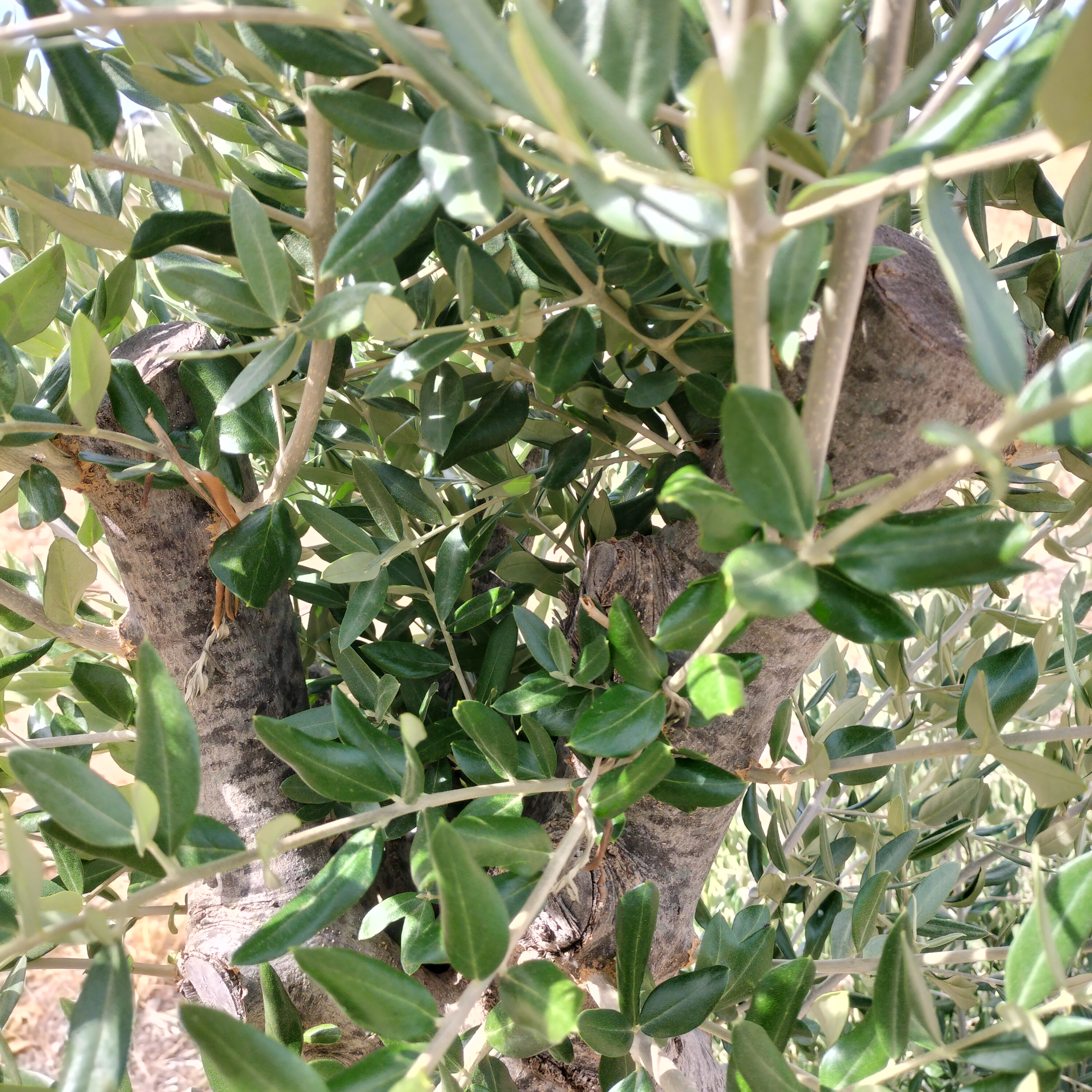
It can also be used to renovate the canopy of olive trees trained for hand harvesting which are transitioning to mechanical shaker harvesting methods, although harvest tonnage will be reduced for at least two years following full canopy removal.
If you’re starting from scratch with newly planted olive trees, begin the pruning regime within five years of planting them.
This gives the root mass time to establish sufficiently, so the trees will recover best from their initial training prune.
You’ll want to remove anywhere from one- to two-thirds of the tree’s main leader with that initial cut, depending on the role you want your olive trees to play in the landscape.
Most people who use olive trees to create a hedge or windbreak essentially allow the trees to grow wild over time.
However, the privacy and wind break properties of an olive hedge without pruning management will degrade as they grow.
As the olive trees get taller, they produce fewer branches off the main trunk close to the ground.
Suckers may emerge, but this is usually in response to tree stress either through animal, pest or disease damage.
Dense suckers at the base of the trees, combined with unpruned canopy reaching towards the ground are a recipe for increased fire risk.
It’s a much better approach to set up new hedge plantings for multi-trunk growth by removing the main leader at 10-15cm above the ground at the first pruning, which should occur 1-2 years after planting.
This allows the tree to grow wider, establish multiple secondary branches, from which the tertiary, leafed and fruiting branches can develop.
These secondary branches can then be managed as if they were each individuals trees following the pruning principles below.
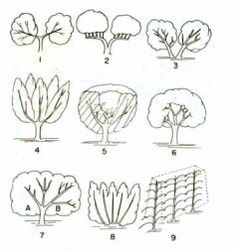
Alternatively, for hedges and windbreaks, refer to the management of high-and super-high density groves at http://www.mediterraneangardensociety.org/olives.html.
Where olive trees have been established with the aim of gaining a harvest (whether that’s in a primary production enterprise or just in the backyard), the first prune should happen 4-5 years after planting.
It is important to take into consideration the harvesting method to be employed at this time.
Mechanical harvesting by tree shakers requires the tree have at least 1.2-1.5m of clear trunk before the fork of the secondary branches occurs.
This is best achieved by pruning the leader above any secondary laterals higher than 1.2m so three or four laterals are present at the height of the cut.
Any growth from the trunk below these laterals (which will become the secondary framework for the fruiting branches) should be removed.
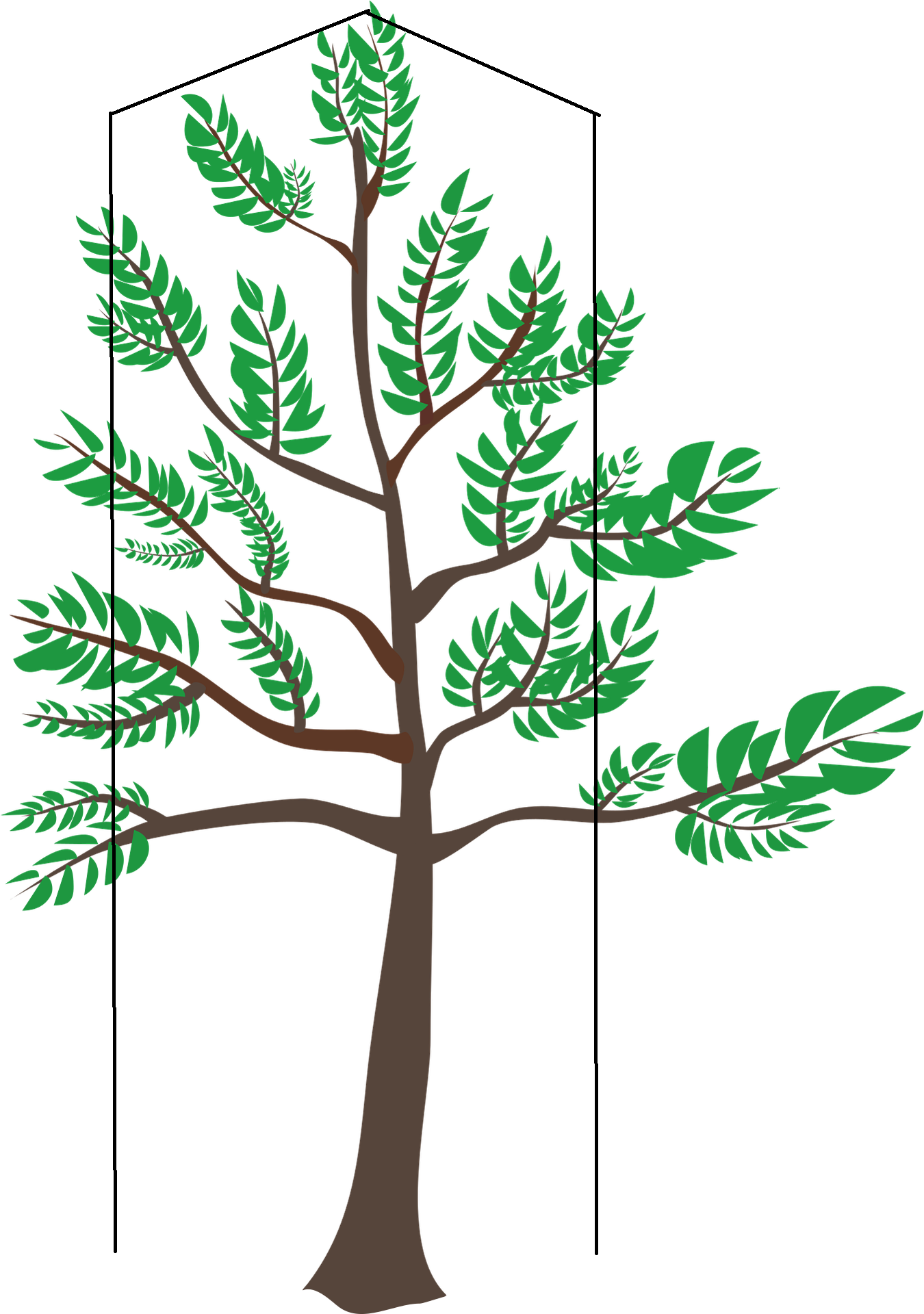
For hand harvesting, the initial prune will only remove the top third of the tree, again cutting the main trunk above any four established lateral branches to develop the canopy width.
Unless the grove is deliberately planted at high- or super-high tree density per hectare with the aim of fully mechanised grove management, allowing sufficient trunk clearance to enable choice in future harvesting methods is the best grove establishment practice.
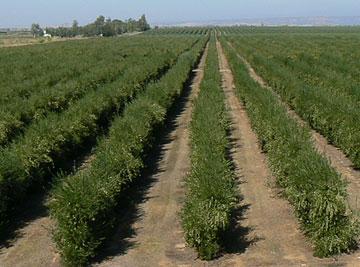
If your grove is of sufficient size or design for ‘over-the-row’ harvesting as many modern high- and super-high density groves are, early growth pruning will not be required in the same way.
The trees won’t require pruning beyond the removal of any suckers at ground level in the first 5-10 years.
After that, the tree canopy can be pruned using tractor hedging attachments to maintain the canopy width within the straddle harvester accessibility (usually 2-3m wide), and to keep the height under control as well.
As olive trees have a low apical dominance, it is important to form a ‘pitch’ at the top of the hedged canopy which consists of at least a 10° decline from the middle of the row out to the edge to prevent the rows from becoming excessively wide and difficult to access with machinery.
So long as the top of the row is pitched in this way, the main volume of the canopy can be pruned perpendicular to the ground with little issue.
Cutting the tips of the canopy branches will usually cause the olive tree to produce new growth closer to the trunk of the tree.
Again, this is because of their low apical dominance.
Where pome and stone fruit will produce a single shoot from the bud closest to the pruned section, olive trees will produce multiple shoots from the pruned section, usually nowhere near the cut itself.
Therefore continuous tip pruning of your olive trees (whether manually or by machine) will create an incredibly dense canopy over time, which can increase pest and disease issues for grove management and decrease harvest efficiency.
It is good practice to selectively remove the large secondary branches on a rotating basis to help thin the canopy, especially where fruit production is desired.
Alternatively, in majority machine-managed high- and super-high density groves, it will be necessary to send manual pruning teams out to thin the canopy at various times as well.
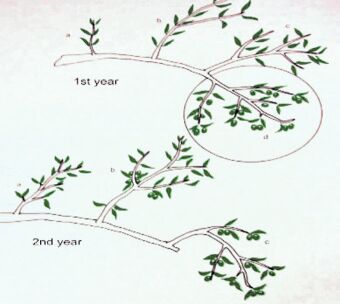
This canopy thinning should be undertaken after a heavy cropping year because the fruit of the olive tree grows on the three- and four-year old twigs within the canopy.
By pruning the trees heavily after a heavy crop, the tendency for biennial bearing can be reduced as the trees will increase the yield on what would otherwise have been an ‘off’ year, which reduces the ‘good’ year in the next season as well.
The age of the canopy and productivity of the twigs can be determined by where the fruit develops in relation to the length of the fruiting branch.
Three-year old wood produces olives at the tip and four-year old wood produces olives closer to the branching point of the twig from the trunk or secondary branches.
Once the four-year old wood has fruited, it will produce new growth for future fruiting branches but won’t have any fruit on there again itself.
The most common way to manage this regeneration cycle is to remove one secondary branch per tree, per year.
That way, the tree is always growing replacement fruiting wood, but maintains productivity through having mature, fruit producing canopy at all times as well. Another approach is to pollard every fourth tree in the grove every year.
That way, only a quarter of the trees need to be pruned in a given season, reducing labour time and costs.
The downside to this method is overall grove production can be decreased for up to three years while the pruning cycle is getting established.
Pruning will also affect harvest efficiency.
When harvesting by hand, dense canopy requires more careful observation to find the fruit, and more passes of the hand-held rakes to remove it.
If electric shaker rakes or tree shaker technology is used, vibration is applied to the tree trunk or branches. Where this vibration has to travel a longer distance over larger diameter branches before reaching the fruit bearing wood, vibration transfer in the canopy is reduced.
This requires either greater vibration be applied to the tree, or longer shaking session, whereby greater damage to the tree’s roots can occur.
The larger the difference between trunk and/or secondary branch diameter and the diameter of the fruiting wood, the better the vibration transfer.
By keeping the canopy width within the available umbrella net of a tree shaker, less fruit is lost during harvest as well.
Whatever the function of your olive trees, they will be healthiest and most productive if you actively manage them with annual pruning.
Pruning minimises fire, pest and disease risks in your grove, while allowing more effective integrated pest and disease management (IPDM) and harvest activities to be carried out.
Having a long term goal for your olive tree(s) production and management requirements will help you to determine the best way to prune for your grove.

