

Avocado
-
News
Precision electric frost protection. Lower running costs. Reduced maintenance. Proven performance.
Frost protection remains a critical investment for orchardists, but the decision-making environment is shifting.
Growers are now operating in a more complex landscape where fuel volatility, supply uncertainty, and sustainability expectations are as influential as performance and coverage.
As a result, electric frost fans are emerging not as a future upgrade, but as a practical, field-ready alternative for orchards with reliable access to power.
Fuel volatility is reshaping decisions
Fuel has become an increasingly unstable input in recent seasons.
Geopolitical tensions, supply chain disruption, and energy policy shifts have contributed to fluctuating diesel prices and occasional supply uncertainty.
For frost protection – where response time is critical – this introduces operational risk beyond cost alone:
- fuel availability during peak frost events
- exposure to sudden price spikes
- dependence on external supply chains
For many growers, this is prompting a reassessment of how frost systems are powered.
Electric frost fans: proven platform, flexible power options
Electric frost fans are not new, but advances in motor efficiency and control systems have significantly improved their viability.
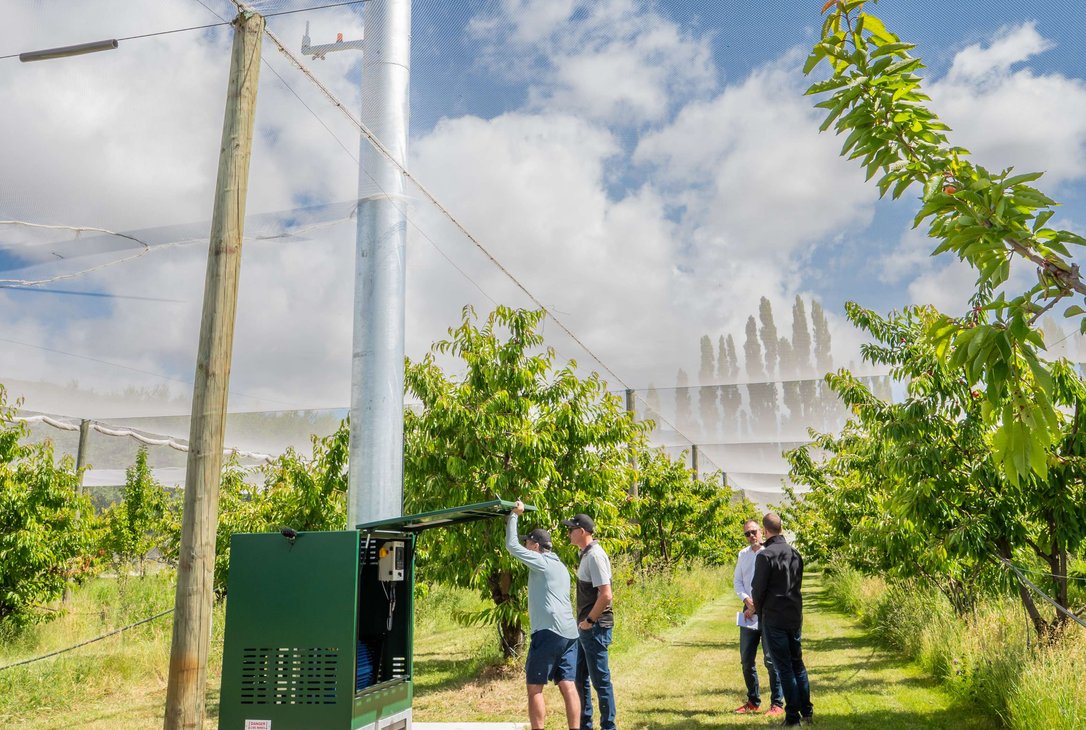
Machines such as the FrostBoss C39 Electric are built on the same aerodynamic platform as proven diesel models, delivering good coverage with a different energy source.
Powered by a 55kW three-phase electric motor, the Electric C39 provides an efficient solution for orchards with moderate infrastructure capacity, delivering reliable inversion mixing and coverage aligned to its class.
For orchards with greater electrical capacity, the electric range extends to larger platforms such as the C49 and C59, both powered by 75kW motors, offering increased coverage and output while maintaining the same core performance principles.
Across the range, the key difference is not performance—but how that performance is delivered: electricity rather than internal combustion.
Lower and more predictable running costs
Electric systems offer a clear operating cost advantage.
As of April, off-peak commercial agricultural electricity pricing in Australia typically ranges around20/kWh.
At this rate, operating costs are approximately:
- Electric C39 (55kW): ~$11 per hour (off-peak TOU)
- Electric C49/C59 (75kW): ~$15 per hour (off-peak TOU)
- Diesel C59: ~$51 per hour (April 2026 diesel at $2.55/L) https://fuelprice.io/diesel/
For context, in 2025 diesel prices averaged $1.84-$1.89/L, resulting in operating costs of $36.80-$37.80 per hour for C59 diesel frost fan.
Over a typical frost season (100 operating hours), total costs are:
- Electric C39: ~$1100
- Electric C49/C59: ~$1500
- Diesel C59 (2025): $3680-$3780
- Diesel C59 (April 2026): ~$5100
This equates to a potential saving of $2200 to $4000+ per fan per season, depending on system size and diesel pricing conditions.
Equally important is cost predictability.
Electricity pricing is generally more stable than fuel, enabling more reliable seasonal forecasting.
Simplified maintenance
Electric systems significantly reduce mechanical complexity.
With no internal combustion engine, there is no requirement for:
- engine oil changes
- fuel filters
- fuel system servicing
This reduces the number of serviceable components, lowers routine maintenance costs, and decreases downtime risk during critical frost periods.
For multi-fan orchards, these efficiencies compound meaningfully over time.
Supporting sustainability objectives
Sustainability is increasingly shaping orchard investment decisions, driven by regulatory expectations and market requirements.
Electric frost fans provide a practical pathway to reduce on-site emissions, particularly when powered by renewable electricity sources.
Using proven platforms such as the FrostBoss composite blade system, their electric models maintain the airflow and coverage required for effective frost protection without compromising performance.
Designed for integration
Modern electric systems are designed to integrate into existing orchard infrastructure.
FrostBoss electric models support retrofit installation with:
- ground-level motor positioning for easier access
- standard mounting footprint
- modular power unit design enables simple conversion from diesel to electric by allowing the unit to be easily swapped out.
This allows growers to transition without redesigning existing frost layouts, reducing both capital cost and operational disruption.
Where electric makes sense
Electric frost fans are best suited to orchards with reliable three-phase power and a focus on long-term operational efficiency.
They are particularly relevant for:
- high-use frost protection zones
- orchards with existing electrical infrastructure
- growers reducing fuel dependency exposure
- operations prioritising cost predictability
Looking ahead
Frost protection remains fundamentally about protecting yield when conditions turn critical.
However, the systems delivering that protection are evolving.
Electric frost fans represent a practical step forward – reducing exposure to fuel volatility, simplifying maintenance, and supporting long-term sustainability goals.
For many growers, the objective is not to replace what already works, but to build greater resilience into the system which protects it.

