Products and services
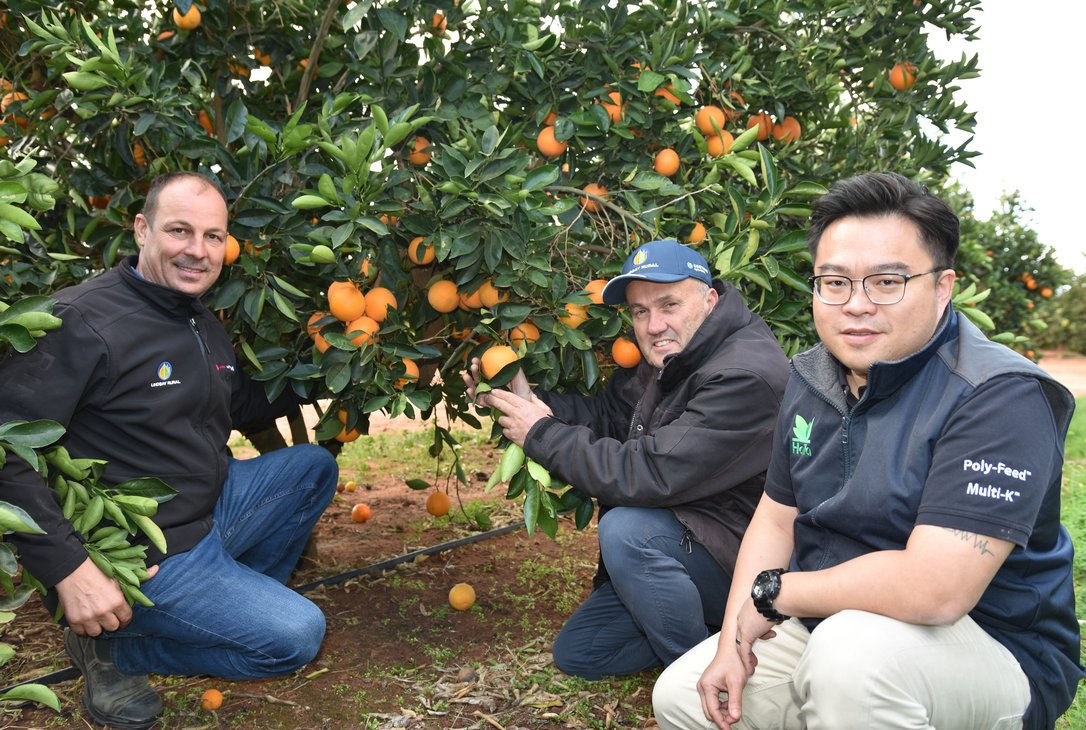
Brett Hullah and his family are looking forward to their Sunraysia citrus orchard coming into production, as well as adopting specialist irrigation and nutrition strategies, and technologies, to help continue improving efficiencies.
Together with his wife, Helen, and brother-in-law, ‘ AJ’, Brett has converted a 32 ha property acquired four years ago near Mildura from winegrapes to grapefruit, while it also produces mandarin and navel oranges.
Brett manages another 20ha property nearby as well.
Grandview Orchards is situated on red sandhill soils offering good drainage and is irrigated with high quality water drawn from the Murray River.
All fruit is processed through the Mildura Fruit Company and mostly exported.
The home-made automated irrigation system, designed by a neighboring software expert, uses both low level micro sprays and driplines, though it is slowly being fully converted to drip irrigation.
During peak demand periods, the system pulse irrigates once to twice daily and they have adopted the “water deficit irrigation” strategy.
“We turn the water off and let the rootzone dry out, and then we turn it on, but only give it half. It has increased our brix and we have not sacrificed size or yield,” Brett explains.
“It certainly has proved itself – and it saves on the water cost.”
Fertilisers are applied twice a week in drip irrigated areas and up to three times where there are low level micro sprays. Broadcasted fertilisers, which can provide nutrient releasing benefits for a month, also are applied in the low level irrigation areas, however they have been moved from between the rows to nearer the trees.
To assist their nutrition strategies, they consult closely with Daniel Lazar, who works with Lindsay Rural at Mildura and also was formerly a grower.
“We have great trust in Daniel and what he says,” Brett said.
“We push the program pretty hard before Christmas, with pruning and then making sure the trees have everything they need via fertigation and foliar applications. About 60 per cent of our nutrition is applied before Christmas.
“It’s more of a maintenance focus after Christmas, to grow something each week – and we can push size if needed.”
Daniel says leaf tissue analysis and assessment of flowering and crop loads guides their nutritional strategy and they target the use of high quality fertilisers including Haifa’s Multi-K potassium nitrate, Haifa Cal calcium nitrate, Poly-Feed and, more recently, its EDDHA iron chelate supplied in a unique bucket.
Haifa’s iron chelate offers 6 per cent iron and, more importantly, is the most stable in soils, with an ortho-ortho (stability) percentage of 5.2.
The higher ortho-ortho level ensures more efficient use of the nutrient and improved production and quality, especially in high pH soils.
Daniel says he also used the Haifa fertilisers when he was a grower, and, in conjunction with other farmers, he had strong experience with alternative products, mixing of fertilisers and the troubles that could occur with lower quality products.
Liquid potassium thiosulphate is used early in the program and Brett says he particularly like the Poly-Feed product for fertigation and foliar applications.
“We have used it with our young trees and applied high label rates in specific areas,” he adds.
“On the property we are managing, we proposed a nutrition program and while the older owner said just to follow the normal program there, we did apply a bag of Poly-Feed every three weeks and his mates later said to him, ‘jeez your trees look good’.”
He says after previously using several iron products, he much prefers the Haifa iron chelated micronutrient.
“It mixes quite well and there is less dust with the Haifa iron – and I love the buckets.”
Brett says they will continue striving to improve their application methods, including automation systems, for increased efficiency, which will also help reduce labour requirements in the orchard.
Daniel says continuing to look at trials and adopting new technologies, including new mapping tools, also could help to achieve further production improvements.