

Water supply & irrigation
Talha Shahzad
The Bureau of Meteorology has forecast an El Niño spring, characterised by warmer ocean surface temperatures in the central Pacific, which can cause drier summers and warmer daytime temperatures.
Water use efficiency becomes critical in those conditions. It makes it more critical to save every single drop of water and apply irrigation when it’s necessary.
Irrigation scheduling is a critical aspect of growing almonds on heavy soil, as more water stays in the root zone even if it is not required, leading to over-irrigation quite often.
On the flip side, almond orchards on lighter soil may experience under irrigation.
Water budgeting
Annual water requirements for the almond crop can be from 8.5-13ML/ha.
Long-term average water usage, crop yield, and ETs can be combined to estimate how much total irrigation water is required.
A general ET model can provide accurate water budgeting with long-term ETs.
Irrigation Scheduling
Irrigation scheduling is a tough question that needs experience and calculations. It is often misled by gut feelings.
Soil moisture probes are widely adopted in industry to determine how much water is present in the root zone and top up with additional water to fill the profile.
In doing so, sometimes they overirrigate or underirrigate, leading to variety-specific bud failure or leaf-out problems (prevalent in Monterey and Carina varieties).
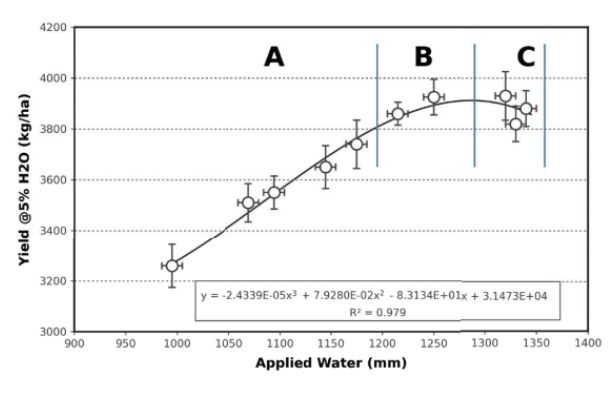
Irrigation and yield are directly correlated in the almond crop (Figure 1). But sometimes irrigation water becomes expensive, so growers want to ensure irrigation only at the critical point without trading off next year’s yield.
The most irrigation-sensitive stages in the almond crop are
Early spring: avoid over-irrigation during this time. Apply full water as per the ETs.
The best way to do this is to irrigate within 2 bars below the baseline on the pressure chamber. Water stress during this period will lead to smaller fruit size and potentially shrivelled kernels.
At rapid cell division time: two months post-bloom time when the corp is setting itself. Water shortage can lead to severe nut drop.
Kernel fill stage: from late Dec to harvest.
Post-Harvest: as the shaking and sweeping are completed, water should be applied, because bud differentiation is happening at that time.
Irrigation scheduling considerations:
Almond is a fairly drought-tolerant crop; slight dry conditions stimulate deep rooting and bring crop maturity early, producing even hull split.
Prolonged water stress negatively influences yield and nut quality and induces alternate bearing.
Spring irrigation is critical if the effective rain is not enough. Trees require water to process all their biological functions. Water stress during this time could lead to nut drop.
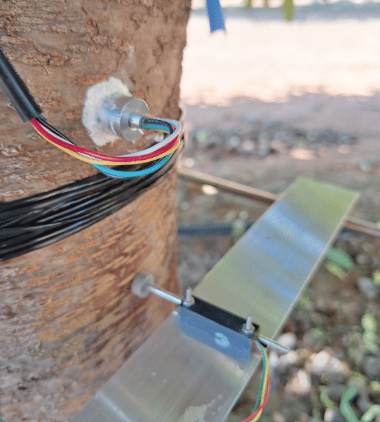
Water can be saved when it comes to hull split time. Let the stem water potential (SWP) come down to -14 to -16 bar, then irrigate. The SWP from -14 to -18 is termed moderate stress.
Moderate stress during the hull split time can even the hull split and mature the crop a few days earlier, which gives a week more time to harvest. Tensiometers can be installed instead, as the pressure chamber is a heavy apparatus and needs expertise to operate.
Lighter soils need more frequent irrigations, whereas heavier soils need less frequent and bigger shots at one time.
More irrigation early in the morning stores water in the soil profile and keeps the tree prepared for midday stress events (especially in summer).
Warmer winter conditions and warmer summer temperatures have a significant impact on overall yield. Hence, keeping a good balance between irrigation and budget is key.
Keeping crops stress-free during the kernel fill period ensures current-year crop quality, and post- harvest irrigation defines next years bloom and crop set.

