
Tractors & machinery
With specialised crops, such as orchards, it’s important to protect the plants against diseases, insects, and other threats.
That’s why controlled phytosanitary treatments must be carried out, which consist of applying chemical and biological products, with the aim of:
- preventing or treating diseases (powdery mildew, downy mildew, etc.).
- controlling parasites (mealybug, moths, etc.).
- combating pests and other pathogens which can compromise quality and productivity.
These operations must be carried out with precision and in a timely manner, making the tractor a fundamental ally, as it helps expedite and optimise the various activities.
Some advantages include the possibility of using atomisers or mist blowers connected directly to the machine, which therefore move at a constant speed, distributing the plant protection product evenly.
In addition, modern tractors like those made by Landini use technological solutions for precision farming, such as the ISOBUS system and GPS devices for assisted parallel guidance, which help optimise product distribution by ensuring precision movement along the rows.
The machines most commonly used to carry out treatments are the following:
- Atomisers: these use fans to distribute pesticides in the form of a fine mist.
- Mist blowers: these create smaller particles than sprayers and are ideal for covering dense areas evenly.
Both provide effective performance, although there are certain differences in the types of crops to be treated.
Tall trees in orchards require atomisers with directional jets to reach the tops.
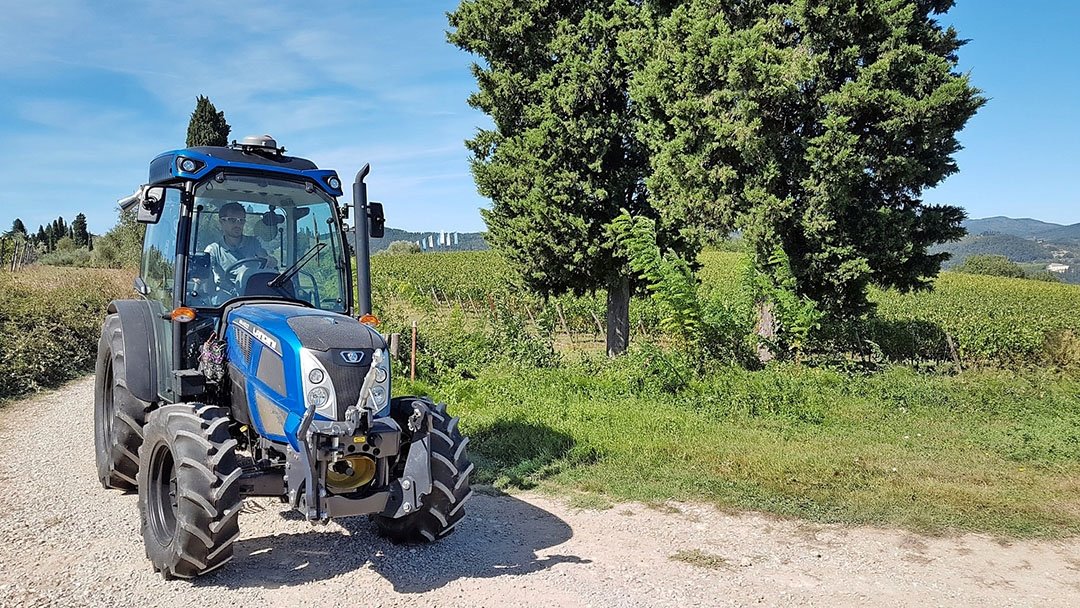
Landini’s wide range of tractors includes several series dedicated to carrying out specialised operations in orchards and vineyards.
Landini’s REX4, for example, with its F, S, V, and GT cab versions, is a worldwide benchmark among specialised row crop models.
The hydraulic system offers the widest range of configuration possibilities ever, ensuring optimised solutions to meet every specific need. The standard hydraulic system features a double pump that supplies 58 l/min to the rear hitch and the spool valves, and 30 l/min to the steering system.
In addition, the cab offers a comprehensive range of driver comforts, with 360° visibility for maximum work efficiency, and is even available with a mechanical suspension system, as well as a multi-function armrest attached to the swivelling seat.
Another feature designed specifically for performing crop treatments is the category 4 roof protection option, which, thanks to active carbon filters and an electronically controlled cabin pressurisation system, guarantees a watertight and healthy environment inside the cap.
Combined with an atomiser or mist blower, this machine is the perfect ally for performing phytosanitary treatments in vineyards and with row crops of various types.

