

Tree crop insights
By Ken Breen, Jill Stanley, Tiff Da Silva, Shona Seymour and Roberta De Bei
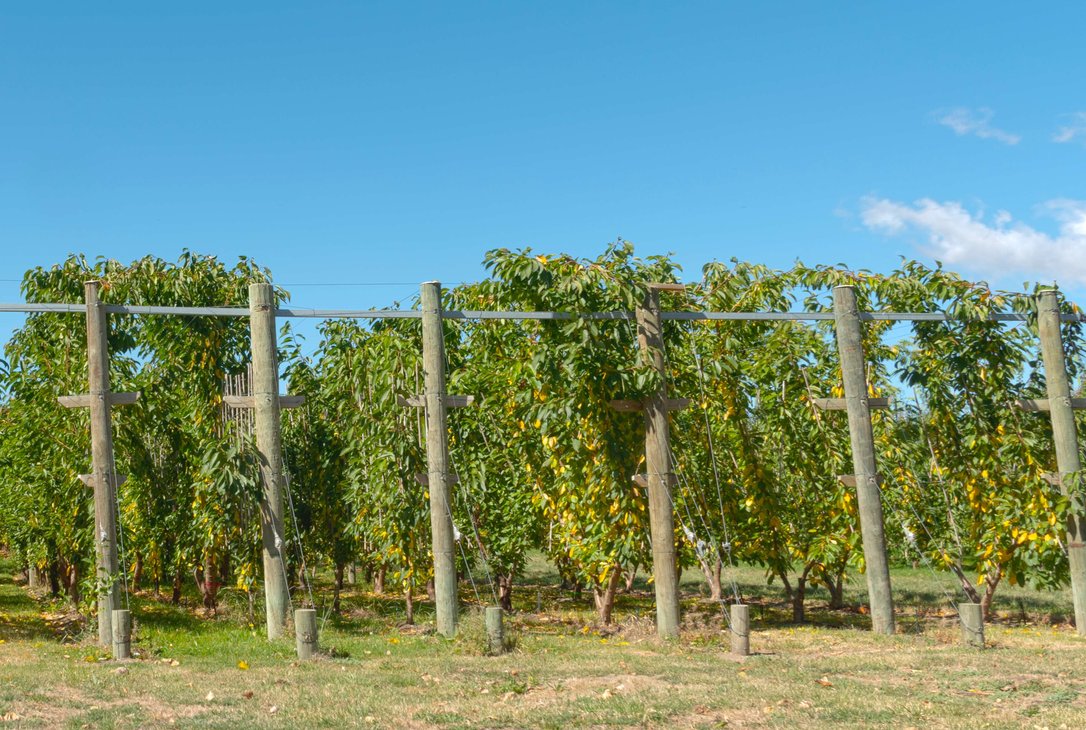
New Zealand scientists have joined the Narrow Orchard Systems (NOS) team to provide their wealth of experience in tree training systems.
They will explore how more of a tree’s resources can be directed to the fruit rather than the branches and trunks in 2D systems.
The shapes and structures (architectures) of trees are controlled naturally by the response of their genetics to the environment they grow in; i.e. the genotype responds to an environment to produce a phenotype.
The way in which annual growth is allocated to the various components of the plant – trunk, branches, roots, fruit – is part of this process.
In commercial systems, our objective is to impose management to manipulate the genetics (scion plus rootstock) and environment, in a way that will optimise our returns, which are generally led by economic targets.
Consequently, we are interested in maximising the harvestable portion of the total annual growth, or in more technical terms, maximising harvest index.
Once the orchard is planted, we have no further ability to choose the genetics, so we are limited to directly influencing the environment – irrigation, nutrition, netting – or managing the phenotype through pruning, thinning etc.
For many of these interventions we have developed technology and targets to assist decisions – soil moisture meters to forecast irrigation, leaf elemental concentration to manage nutrition etc.
The history
In 1675, Charles Cotton noted in his handbook on fruit production The Planters Manual, that “there is no precise instruction to be given for [pruning]and therefore the eye and judgement of the workman must be his rule - only not to suffer branches to grow over one another or to leave too much wood upon the tree”.
Until about a decade ago, pruning decisions were still largely more of an art than a science.
However, in research in the first PIPS program (productivity, irrigation, pests and soils, Horticulture Australia Limited AP09031) and subsequent work in New Zealand, Europe and the US, we established scientifically based metrics for 3D spindle apple trees and 2D trellised systems, which have since been broadly adopted internationally.
Most modern apple cultivars, especially when grown on dwarfing rootstocks, produce many more branches and buds than required for our commercial targets of large fruit size and high eating quality.
The PIPS program showed for the majority of modern commercial apple cultivars grown as 3D spindle trees on dwarfing rootstocks, around six branches per vertical meter of trunk and around four to six buds per cm 2 of branch basal cross-sectional area, optimised light interception without compromising light penetration, thereby maximising potential premium yield.
In other words, harvest index was optimised (see articles in Australian Fruit Grower 2014, Vol. 8 Issues 4, 5 and 9).
This means in 3D spindle apple trees, removing around half of the naturally occurring branches and around two thirds of the buds, sets up the orchard to maximise potential.
The project
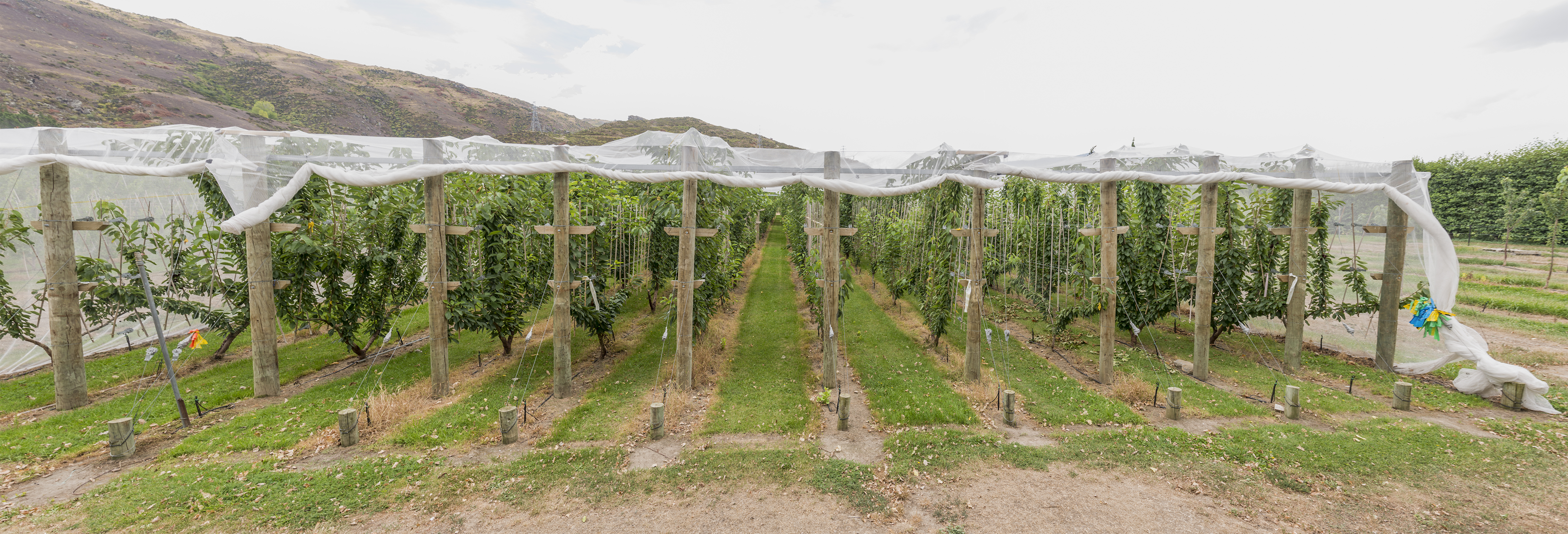
In 2D systems having multiple upright stems (e.g., bi-axis, trident, UFO, Guyot, Planar Cordon), we know little of how growth is allocated to the components of the plant, which restricts our knowledge on how to manage these trees, especially in narrow rows.
For example, if we’re interested in pedestrian orchards, what effect does the number of uprights have on the height of those uprights?
How do cultivar and rootstock (genetics) affect that?
In the next three years as part of the Narrow Orchard Systems for Future Climates project, we aim to answer two questions:
- What is the impact of different 2D tree configurations (e.g., number and spacing of uprights) on yield?
- What is the most appropriate Planar Cordon training management to establish a narrow-row pedestrian orchard?
To achieve this, three experiments will be conducted concurrently, in mature pears at Tatura Smart Farm, Victoria, across 12 months, and in commercial cherry and apricot orchards in New Zealand through three years.
Results will be reported to the Australian industry during field days, orchard visits, and through industry articles and reports.
We look forward to meeting you at some of these.
Background
The authors are science staff at Plant and Food Research, a Group of the newly created Bioeconomy Science Institute, New Zealand.
Between them they have many years of international experience in research and advisory roles on narrow-row, planar orchard systems for pome- and stone-fruit, and in production and environmental physiology of deciduous fruit trees and vines.
They are currently leading a number of research programs in cherries, apricots, almonds, apples and pears, to understand tree behaviour in these systems.
The authors are science staff at Plant and Food Research, a group of the newly created Bioeconomy Science Institute, New Zealand.
Between them they have many years of international experience in research and advisory roles on narrow-row, planar orchard systems for pome- and stone-fruit, and in production and environmental physiology of deciduous fruit trees and vines.
They are currently leading a number of research programs in cherries, apricots, almonds, apples and pears, to understand tree behaviour in these systems.
Further details from the NZ Institute for Bioeconomy Science Limited or ken.breen@plantandfood.co.nz

