
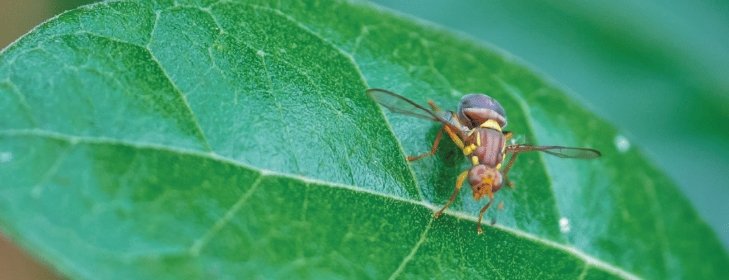

Citrus
-
Fruit Fly
-
Marketing & export
Good orchard hygiene is essential in breaking the fruit fly lifecycle.
The Goulburn Murray Fruit Fly Area Wide Management Program works with growers and the broader community to ensure effective post-harvest hygiene is achieved.
Now is the season for fruit flies to build up before the cold hits and if they survive the winter, they will start a new season of fruit damage next spring.
This is where orchard (or post-harvest) hygiene becomes important, says program coordinator Ross Abberfield.
“You will break the fruit fly cycle by successfully cleaning up your orchard, home garden and nearby untended land of potential fruit fly host material,” he says.
“It’s really simple – no fruit, no fruit fly.”
Key steps:
• removing or reporting volunteer or neglected fruiting plants.
• control of alternative hosts.
• destruction of crop residues after harvest.
• destruction of unwanted and waste fruit.
• reporting suspect pests to appropriate authorities.
• don’t leave ripe fruit on the tree or let it fall to the ground (this gives fruit flies a chance to breed).
• pick fruit early (as fruit ripens it becomes more attractive to fruit flies).
• prune trees so you have easy access to fruit. If the tree is loaded with fruit (more than you can manage to use) strip off some early on. This way you will have better fruit produced and be able to use it all.
• dispose of spoilt fruit by placing in a heavy-duty black plastic bag, seal and put in the hot sun for a few days to ‘cook’ the larvae or bury the spoilt fruit in a deep hole (more than 50cm deep and covered and tamped down immediately).
Tarps, black plastic or shade cloth could also be placed on the ground under the fruit tree to catch fallen fruit and prevent maggots from pupating (thus breaking the lifecycle).
Other benefits come with good orchard hygiene – to most growers the common practice is to remove any damaged fruit, or to mulch it each day with a mulcher or flail mower, so it breaks down or disintegrates quickly.
This practice is important as it reduces places Qfly females can sting and minimises the possibility of new generations of Qfly developing in the field.
It is also a widely used practice in most stonefruit operations to reduce the occurrence of Carpophilus beetle and the incidence of brown rot.
Seasonal alerts
In July to September Qfly population emerges from overwintering and commences breeding. Fruit infestation occurs late in winter to early summer by flies from the previous autumn which have overwintered.
From October through to February is the time of Qfly population expansion – and medium levels of damage. Hosts for subsequent Qfly populations assist in the rapid expansion of Qfly damage. The weather at this time of year is optimal for fruit fly survival.
Back to March, April and May, we face population consolidation – and high levels of Qfly damage and breeding populations for the following season.
Qfly adults move to refuges to survive the winter then re-emerge in early spring.
Finally, in June, the population is reduced as the eggs, larvae and pupae die out.
Adult Qfly overwintering occurs in localised warm urban and rural climates – as well as in evergreen trees/plants.

