

Almonds
-
Featured Crop
By Muhammad Asad Ullah and Dario Stefanelli, research scientists, Department of Primary Industries and Regional Development, Manjimup, WA.
Two-dimensional (2D) multileader narrow orchards, characterised by tightly spaced rows (typically 2-2.5m) with planar cordon canopy training, are emerging as the future of modern fruit production to meet the challenges of labour shortage, resource efficiency, and sustainability.
In Western Australia, the Department of Primary Industries and Regional Development (DPIRD) is conducting trials, as part of the national AS22002 Narrow Orchard Systems for Future Climates (NOS) project, to evaluate new Australian bred apple cultivars and latest available rootstocks, along with a suite of agricultural technologies (AgTech) to support and evaluate more efficient orchard management.
The key objective of the NOS project is to create more uniform orchard structures which:
- Simplifies management and lowers operating costs.
- Improves light interception and fruit colouring.
- Provide consistent quality and higher yields per hectare.
- Are labour safe and efficient for tasks like pruning, thinning, and harvesting.
- Facilitate mechanisation and automation.
However, servicing these orchards remains a challenge owing to the narrow spacing and lack of manoeuvrability in tight rows.
Traditional orchard machinery, such as tractors and sprayers, is often too large or inefficient in these orchards.
While adaptations of traditional machinery can sometimes suffice, specialised equipment is often needed to operate efficiently in these orchards.
Currently, the available options are either limited or too costly for relatively small-scale growers.
DPIRD WA is trialling a variety of orchard management equipment, befitting the narrow row configuration, to address these challenges and provide an ad hoc management package to Australian growers by the end of the project.
Recently, a NOS field day was held at Manjimup Horticulture Research Station demonstrating an autonomous sprayer (S1000 – LJ Tech – www.ljtechag.com ) designed to fit between narrow rows (Picture 1).
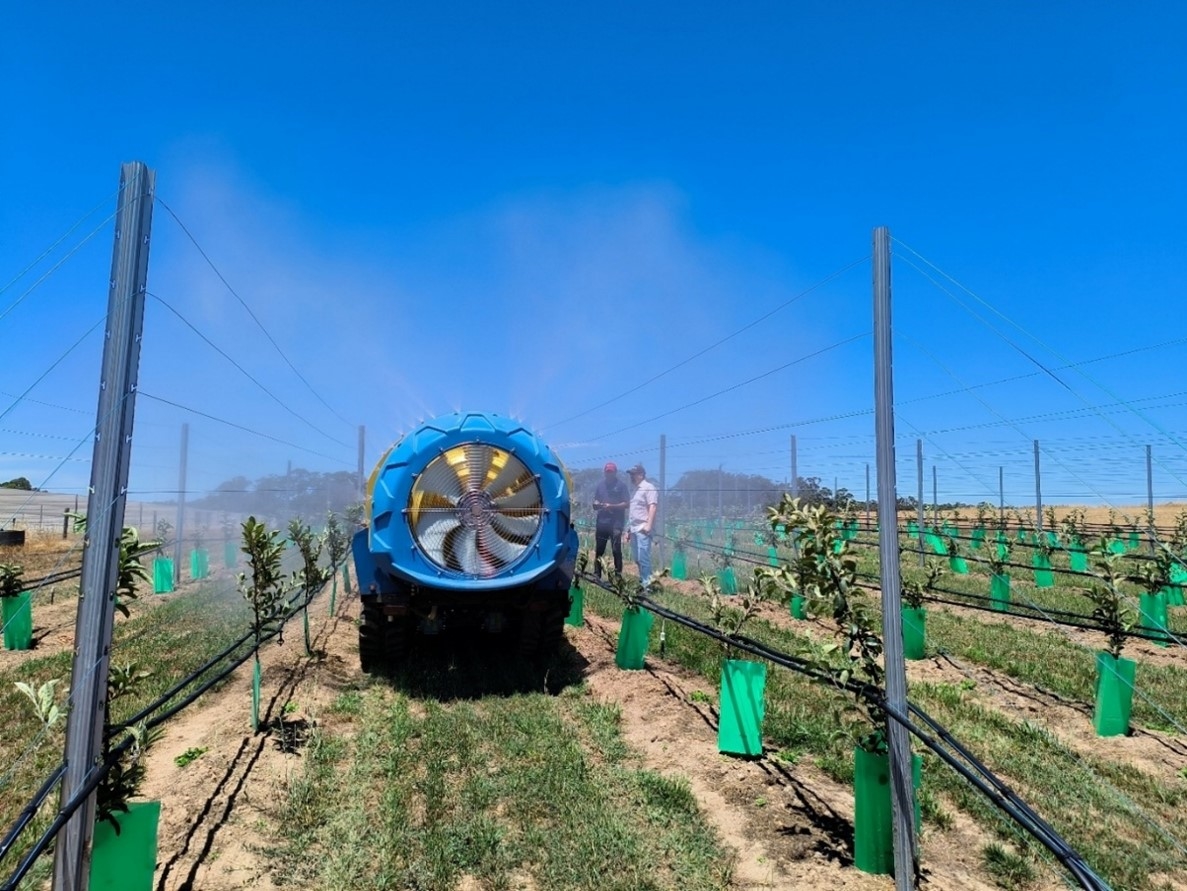
Equipped with precise positioning, dosage control and intelligent spray system, the sprayer offers a cost-effective option, particularly for small-scale growers aiming to automate their spraying operations.
Additional benefits include:
- Cost-effectiveness over time through reduced labour inputs.
- Improved farm and labour safety through reduced chemical exposure.
- Precise and consistent spraying, which prevents chemical overuse and spread.
- 24/7 operation potential, improving flexibility during critical spray windows.
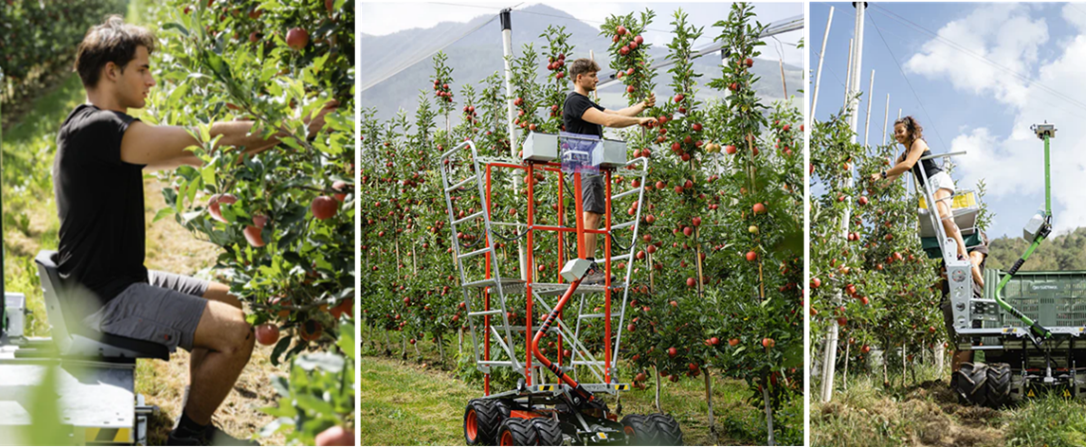
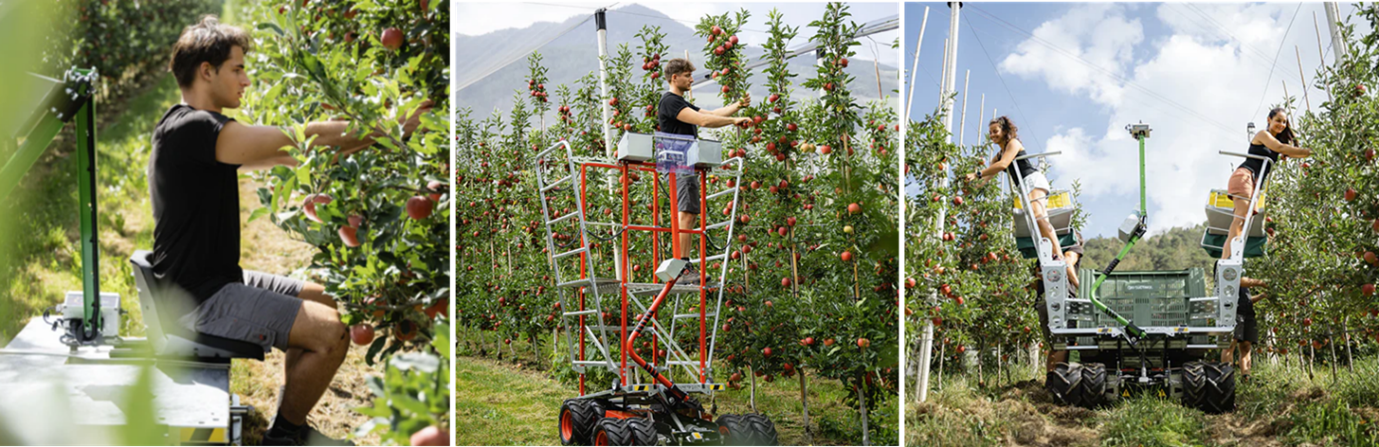
Another innovation being trialled is the Frucotec multifunctional orchard management platform.
With customisable platform add-ons, adjustable height and a compact design, it fits easily into narrow rows and reduces the need for ladders and repetitive strain-inducing manual work.
The platform increases worker safety and productivity and supports a range of tasks including, tree training, pruning, thinning and harvesting.
This economical option for orchard management is ideal for resource-limited growers.
Western Australian fruit growers will have the opportunity to see it in action in the next growing season.
DPIRD is also developing and evaluating an in-field apple sorting system in partnership with Outback Robotics -a WA based robotics company.
This prototype system based on optical recognition, will enable real-time size-based apple sorting during harvesting in the field.
Field evaluation of the apple sorter will be carried out in the coming cropping season with customised integration into the Frucotec platform.
This integrated solution will allow a more streamlined and efficient harvest process, on-the-spot fruit grading, reduced postharvest handling and provide better and early insight into storage needs for premium sized fruit.
To evaluate precision crop management, DPIRD has deployed a suite of sensors in its trial blocks, including dendrometers (trunk, fruit, shoots) and soil moisture sensors for targeted irrigation and to monitor tree water status, growth, and stress response in real-time (Picture 3).
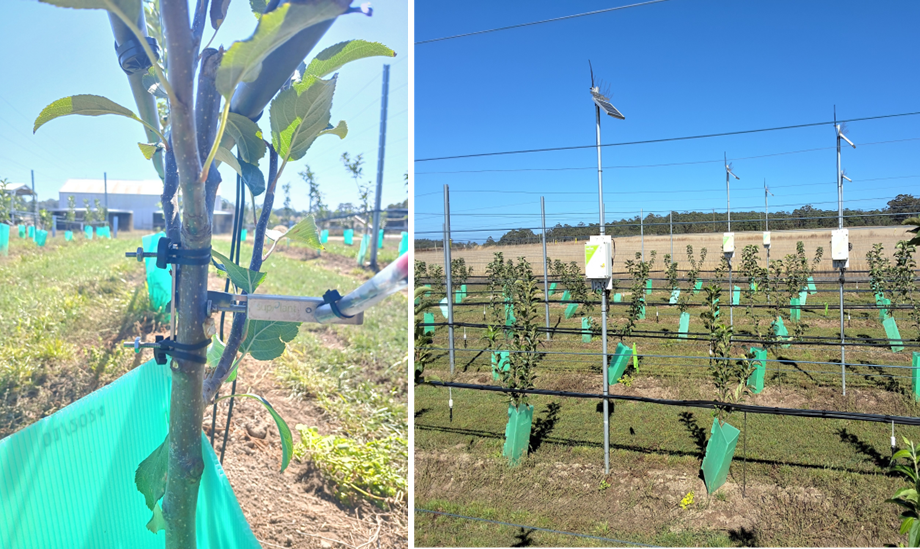
These tools offer a clearer picture of what’s happening in the orchard, allowing for timely interventions and improved resource use efficiency.
In addition, an open-source data visualisation dashboard is being developed in collaboration with Tobias Industries ( www.tobiasindustries.com ) to integrate data from various sensor types and/or providers into a single platform as a decision support tool to manage orchard operations e.g., irrigation.
Narrow row multileader orchards with 2D uniform canopies are ideal candidates for full automation in the near future including for computer vision enabled robotic pruners and harvesters capable of selective pruning and fruit picking.
While many of these technologies are still in development or pilot stages, the foundational orchard structure being trialled by NOS is critical to enabling their future adoption.
In addition to DPIRD WA, the other national project partners are trialling a range of equipment and technologies to assess their use and suitability for not only NOS but also existing orchard systems.
Some of the notable examples are:
- Auto retractable netting (Agriculture Victoria).
- Ground based imagery and LiDAR (Agriculture Victoria).
- Autonomous vehicles for mowing and slashing (Agriculture Victoria).
- Digital twins to simulate and model spray efficiency and efficacy in NOS (UQ).
- Labour tracking technology (SARDI SA).
The transformation of orchards towards 2D multileader narrow row systems is a practical response to the need for greater efficiency, safety, and sustainability.
From autonomous sprayers to real-time fruit sorting and precision monitoring, the integration of smart technologies is key to delivering a commercially viable, future-proof orchard system for Australian fruit growers.
As these trials mature, industry can expect a comprehensive orchard solution that aligns superior cultivars, orchard design, and technology — making the next generation of orchards not only more productive, but smarter and safer.

