

Business solutions & labour
In the orchards of the future, cherry pruning and thinning could be entrusted to robotic arms and smart algorithms.
The Cherry Times reports a team of American researchers is developing advanced systems based on artificial intelligence and robotics to make these operations more precise, sustainable, and less labour-intensive for workers.
The project, led by the universities of Oregon and Washington, began with a focus on delicate crops such as berries, but aims to extend applications to other valuable tree species, such as cherries.
First field trials
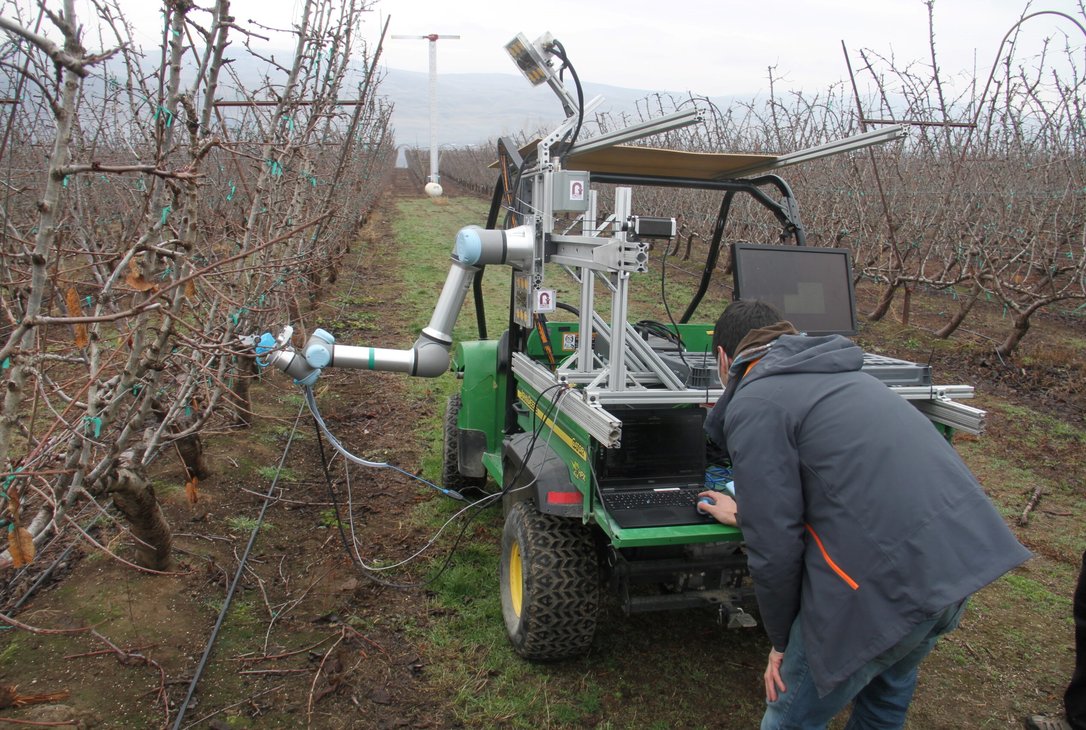
In Prosser, Washington, a vehicle equipped with a robotic manipulator carried out field tests using a camera integrated into the hand of the mechanical arm.
This configuration made it possible to autonomously identify the exact pruning points and perform cuts with electric bypass shears.
The result?
A concrete first step toward the intelligent robotisation of orchard operations.
Field research and collaborative approach Joe Davidson, associate professor of robotics and mechanical engineering at Oregon State University (OSU), presented the progress of this research at the FIRA USA conference, dedicated to agricultural robotics, held in Salinas, California.
“From the beginning, we decided to bring our systems directly to the fields,” Joe says.
“Our goal was to understand where our ideas could really work and where solutions needed to be rethought.”
AI and machine learning to support workers
At the centre of the research are human-machine collaborative systems, designed to boost orchard labour productivity, improve fruit quality, and optimise yields.
The technologies developed are based on artificial intelligence models trained with high-definition RGB images, capable of guiding pruning tools with precision.
To address challenges related to variable weather conditions or uneven lighting, researchers are combining computer vision with force sensors, giving robots a true sense of touch.
This approach enables more precise and delicate cuts without damaging adjacent branches.
Virtual simulations and digital trees
One of the most innovative aspects involves the use of digital tree models.
These simulations, based on realistic models of growth, light distribution, and carbon transport, allow algorithms to be trained in virtual environments.
This method accelerates development and reduces errors in the image labelling stage.
“With digital trees, we can run reinforcement learning sessions,” Joe says.
“The robot learns directly from the simulation, improving its performance even before working in the field.”
Towards more comprehensive agricultural robotics
Upcoming developments include tests with professional pruners to refine operational rules and create digital training tools for seasonal workers.
In addition to cherries and apples, researchers are adapting these technologies for blueberries, a crop of particular importance in Oregon and Washington.
Applications also extend to other areas: from monitoring trunk surface to assessing plant vigor, and even in precision fertilisation projects.
Automation as an ally
The AgAID Institute team, beyond technical aspects, is also conducting sociological research: through interviews and field observations, they study how workers interact with these technologies.
The goal is clear: to develop tools which support human labour, reducing physical strain and increasing the sustainability of fruit production.
A vision of the future where AI and agriculture walk hand in hand, creating more efficient, inclusive, and resilient fruit farming.
Source: fruitgrowersnews.com

