
Tree crop insights
By Maddy Peavey and Alessio Scalisi (Agriculture Victoria)
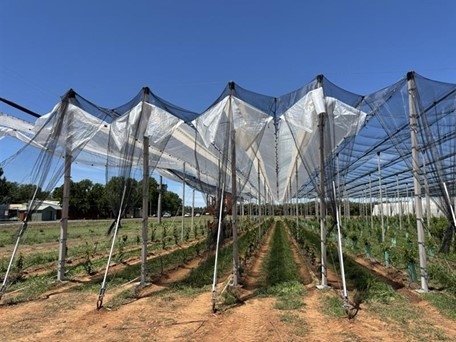
Orchard covers are a key to managing climate risks but can reduce sunlight transmission by up to 47 per cent.
Sunlight plays a vital role in fruit production, so what is the cost to production and quality?
Sunlight is made up of a wavelength spectrum ranging from approximately 300 (ultraviolet) to 2500nm (infrared). Visible light (i.e., what humans can see) ranges from 380 (violet) to 780nm (red).
Plants primarily use visible light in the 400-700nm range to photosynthesise (referred to as photosynthetically active radiation, PAR) and in the 600-750nm range to stimulate flower initiation.
Fruit such as apples and grapes also needs ultraviolet light to stimulate peel red colour.
The visible spectrum of sunlight, and ultraviolet for some crops, is therefore critical for fruit production.
The perfect protective cover material would let through 100 per cent of the visible wavelengths of sunlight and absorb and reflect the infrared wavelengths.
Scientists at the Tatura SmartFarm have been studying sunlight transmission under the various protective covers over orchards using spectroradiometry.
Spectroradiometry is the technique of measuring the spectrum of radiation emitted by a source, which in this case was the sun.
Sunlight transmitted through orchard covers such as netting or rain covers is affected both quantitatively and qualitatively.
In other words, the amount of sunlight that passes through a protective cover will vary with its wavelength.
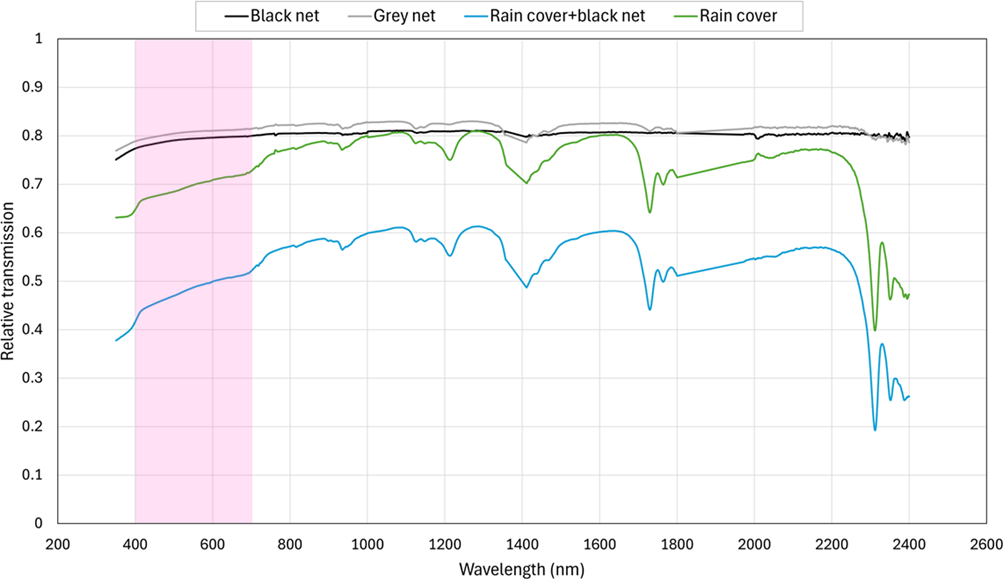
Measurements were performed on February 14 in 2025 under clear sky conditions.
The equipment used was a FieldSpec 4 (ASD Inc., Boulder, Colorado, USA) spectroradiometer, which has a resolution of 1nm in the Visible/Near-Infrared (VNIR) and Short-Wave Infrared (SWIR) regions.
The protective covers investigated were black netting, grey netting, and a combined plastic rain cover and black netting (rain cover and black net).
All these covers were manufactured by Valente Srl (Padova, Italy).
The light transmission through the plastic rain cover on its own was deduced from the difference between the black net and rain cover and black net treatments.
The grey and black nets reduced radiation transmission by 19 per cent and 20 per cent, respectively, across the whole spectra (350-2400nm).
In the same spectra, the plastic rain cover, and the cover and black net treatments reduced light by 26 per cent and 47 per cent respectively.
In the PAR range (400-700nm), the fractional interception was 19 per cent, 21 per cent, 30 per cent, and 52 per cent for black netting, grey netting, plastic rain cover and cover and black net protective covers, respectively.
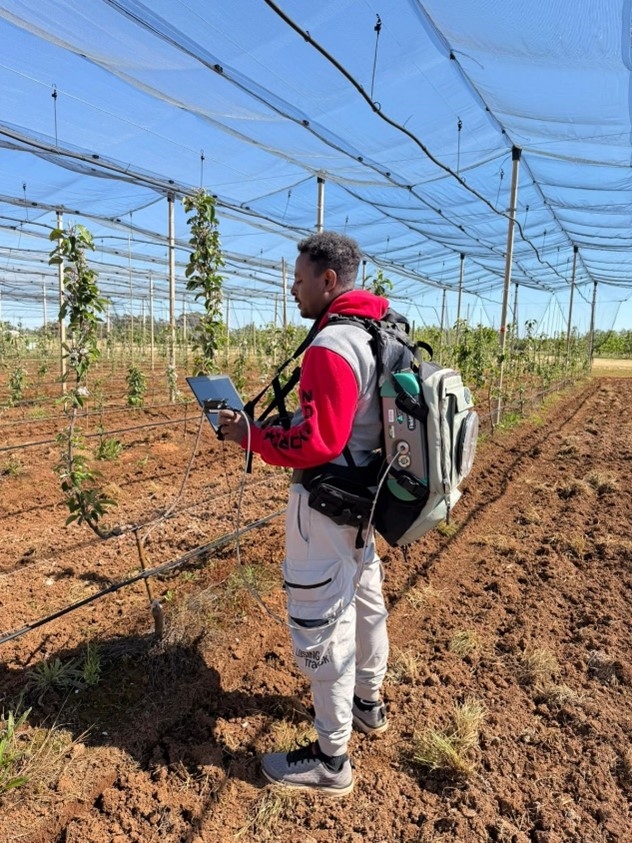
The plastic rain cover appeared to severely reduce light transmission in the PAR region.
These preliminary results provide an opportunity to better understand crop-specific responses to different protective materials.
Radiation is crucial for maximising yield and optimising fruit quality.
Previous research on pears at the Tatura SmartFarm has shown radiation reductions of more than 30 per cent can significantly lower yield, fruit size, and red colour development.
Nevertheless, some crops, such as cherry, may tolerate additional shading – potentially benefiting fruit quality – as plastic covers can prevent fruit cracking caused by excessive rainfall in the lead-up to harvest.

