

Tree crop insights
The Century Orchards almond enterprise near Loxton in South Australia’s Riverland region is well-known for its high input, high production focus, as well as its openness to industry, and its latest moves have contributed to further improvements in production.
Compared to the almond industry’s average yield below 3.25 tonnes per hectare, Century Orchards’ long-term average is above 4t/ha.
“A 200kg/ha gain can mean an extra $2000/ha in returns on the current market pricing,” the business technical manager Gemma Jealous says.
“We have worked out what we could do to improve things – and it’s all in the one percenters within our high input, high production approach,” she says.
Century Orchards has up to 700ha comprising from three-year-old to 26-year-old almond trees, plus 100ha of pistachio trees.
Its almonds are processed by Riverland Almonds Hulling at Lindsay Point, just over the border in Victoria, packaged by Riverland Almonds in Loxton, and marketed by Nut Producers Australia.
To guide tree nutrition, a range of monitoring and measuring systems are used, including annual soil analysis prior to harvest; leaf testing in October and January; soil moisture, NDVI and chlorophyll mapping; plus up to eight aerial imaging passes annually.
Gemma says the data had contributed to significant fertiliser adjustments in their mainline, helping to improve consistency of production.
New crop nutrition starts in July with applications of calcium nitrate and boron, followed by iron as leaves emerge.
Century Orchards plans to trial Haifa Australia’s new EDDHA chelated iron micronutrient this season.
Haifa’s iron chelate offers 6 per cent iron and, more importantly, is the most stable in soils, with an ortho-ortho (stability) percentage of 5.2.
The higher ortho-ortho level ensures more efficient use of the nutrient and improved production and quality, especially in high pH soils.
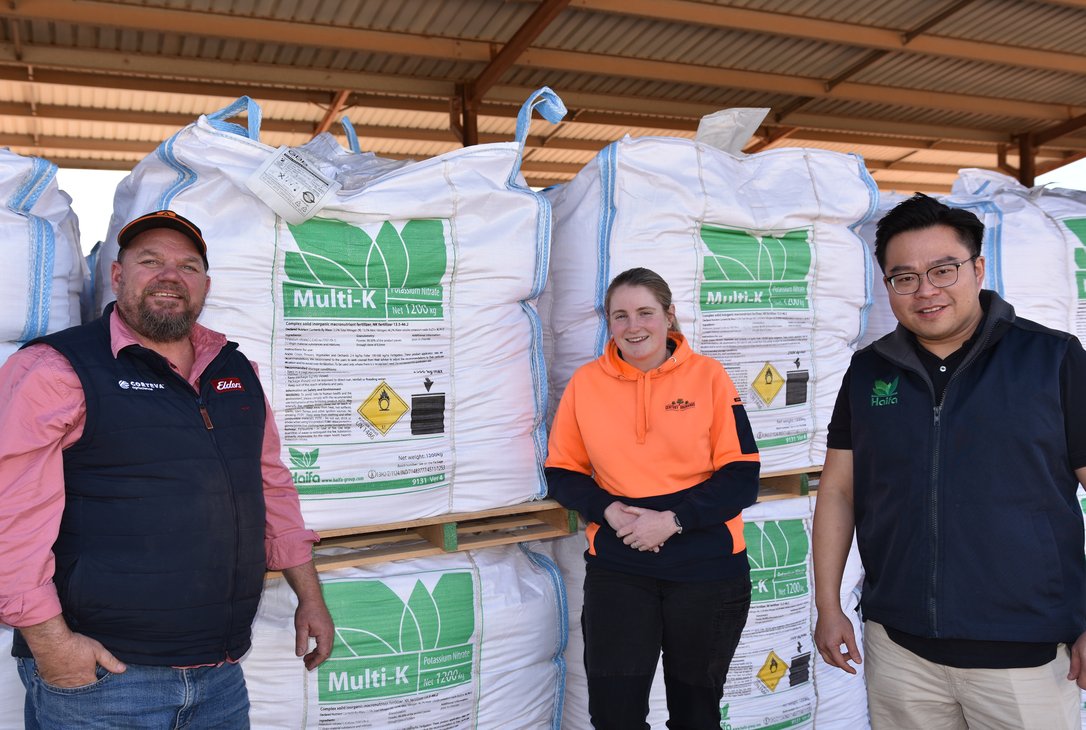
Potassium nitrate applications are heavy earlier in the season, with the property being a long-time user of Haifa’s Multi-K potassium nitrate.
“Some operations use potassium sulphate, but nitrate gives the trees a kick and Haifa is a quality product that doesn’t go hard and it stimulates growth well. We switch to potassium sulphate later to reduce N inputs at that time,” Gemma says.
At pit hardening, potassium application rates are increased, lifting total potassium to 400kg/ha for the season.
“Our brews are heavy, and we fertigate five times a week and irrigate again on Saturday, before irrigating every day over summer.”
Foliar brews, which include the Haifa Multi-K fertiliser as well as the use of fungicides, also can be “quite hot mixes”, so quality products are preferred to avoid any compatibility issues and phytotoxicity.
Century Orchards has switched from using mono ammonium phosphate (MAP) to ammonium polyphosphate (APP) during the season, and micronutrients are applied every two weeks.
A kelp biostimulant product is used two to three times per year, magnesium sulphate also is applied through the season, and there are a number of applications in preparation for following crops.
Liquid Urea ammonium nitrate (UAN) and liquid ammonium nitrate (AN) are used throughout the season for bulking up and storing N for the following season; calcium thiosulphate is used to help open up ground; and potassium sulphate and UAN are used throughout the post-harvest period before switching to MAP or APP fertiliser.
“We try to keep leaves on the trees for as long as we can, but ideally we want to shut the trees down for a month,” Gemma explains.
“We have to plan our brews really well. We want to keep the leaves on to pump carbohydrates for the following year, but the trees also need to sleep to prepare for the next year,” she adds.
Meanwhile, Century Orchards also has been involved in biochar trials for improved soil health and yields, and it is coordinating several projects with the University of Adelaide, One Basin Cooperative Research Centre (CRC) and Osmoflo, including a desalination project.

